
18 May 2026 to 24 May 2026
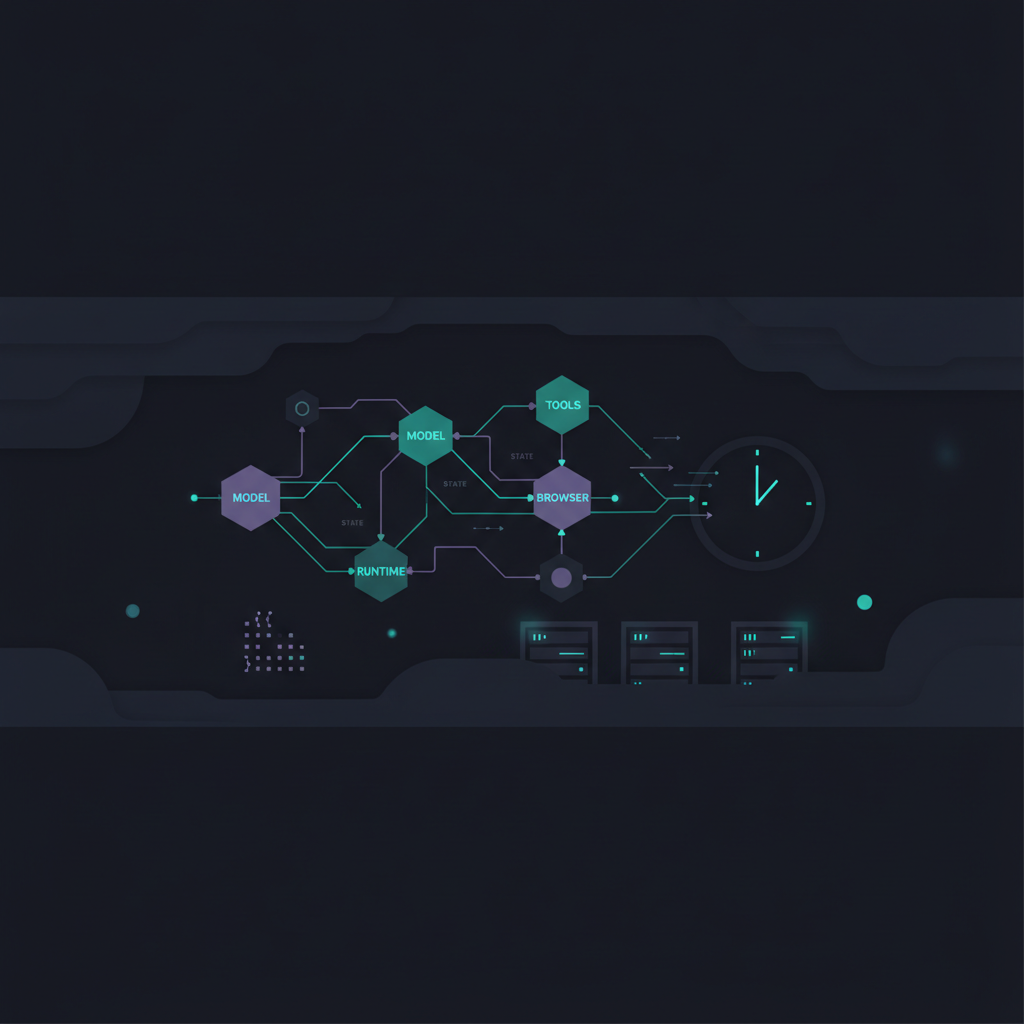
This week's developments show the debate shifting from model capability to the mundane engineering of running agents: orchestration, testing and long‑horizon behaviour are now the product. Vendors shipped bold claims and stack primitives, but most of the practical questions-robustness, observability, synthetic‑data blind spots and scale costs-remain open.
Agents are being sold as orchestration engines, not chatbots
Alibaba's Qwen3.7‑Max is explicit about that shift: the model is pitched to run multi‑step enterprise processes, write and debug code, call tools and stay autonomous for a vendor‑claimed 35 hours. That's not a conversational stunt; it's a different engineering problem where state management, tool reliability and accumulated error matter in a way short chat bursts do not.
Microsoft's Fara1.5 and Anthropic's developer showings are the same story in different uniforms. Fara1.5 targets browser automation with smaller model sizes and tops a benchmark; Anthropic framed Claude as a partner for developers at a London event. Both signal a move from single‑prompt cleverness to continuous, instrumented behaviour-provided those behaviours can be kept useful and safe in the wild.
The stack is emerging - but it's plumbing, not panaceas
CopilotKit's 2026 bundle reads like a practical attempt to make agents manageable: a UI protocol (AG‑UI) to standardise front‑end interaction, AIMock to simulate agents in tests, and a Pathfinder server for runtime concerns. These are the sorts of engineering pieces that decide whether agent projects survive a sprint or collapse into brittle demos.
That said, naming these primitives is not the same as proving them. The release highlights operational gaps everyone is suddenly aware of: how do you handle fairness checks, live observability, governance and failure injection at scale? If AG‑UI, AIMock and Pathfinder don't interoperate with existing toolchains or bake in auditability, they risk becoming another vendor lock‑in rather than a platform for reliable systems.
Benchmarks and synthetic data buy iteration, not correctness
Microsoft's FaraGen pipeline and the Online‑Mind2Web score give neat headlines, but synthetic training tends to bake particular blind spots into agents. Synthetic data accelerates behavioural training without the labour cost of human labels, yet it also codifies the assumptions you used to generate that data-assumptions that often collide with messy real pages and unexpected user behaviour.
Equally, headline metrics and vendor claims need independent scrutiny. Alibaba's 35‑hour autonomy window and Fara1.5's benchmark superiority are useful signals, but they are starting points for sceptical testing, not proof of durable capability. Synthetic pipelines and benchmarks speed iteration; they don't substitute for safety, transparency or reproducible evaluation under real‑world stress.
Reproducibility, scale and the disciplined craft of engineering
The OpenMythos Colab walkthrough is the sort of useful, small‑scale craftwork we'll need more of: runnable recipes, variants to test and concrete checks such as spectral‑radius measurements for recurrence stability. It's a practical lab exercise rather than a system‑level claim, and it shows the value of reproducible experiments you can poke at without a datacentre.
But those lab exercises also expose limits. Techniques like sparse MoE and Loop‑Scaled Reasoning are interesting in a notebook, yet they bring routing complexity, compute costs and training dynamics that only appear at scale. If teams are to depend on agents for days of automated action rather than minutes of suggestion, the community will need thorough benchmarks, long‑running tests and governance that survive production pressure-not just weekend Colab demos or polished conference optics.